
Buying guide
How to Buy Chinese Tea Oil: A Label-First Checklist
A practical buying guide to Chinese tea oil labels: food-use wording, Chinese terms, grades, standards, batch documents, storage and overseas checks.
Direct answer
Start with the actual label, not the phrase ‘tea oil’. A well-documented food product should identify the ingredient, intended use, responsible producer, net quantity, dates, storage instructions and batch information. Chinese terms such as 山茶油, 油茶籽油, 压榨, 浸出 and 调和油 describe different parts of the product story; none of them alone proves purity, freshness or a health outcome.
Key facts
- First check
- Food-use statement and a complete ingredient list
- Most specific common term
- 油茶籽油 — oil-tea camellia seed oil
- Blend clue
- 调和油 means a blended edible oil
- License clue
- 生产许可证编号 is the food-production licence number
- Standard check
- Verify the current standard text through SAMR
- Do not infer
- Purity or freshness from price, natural, premium or cold-pressed wording alone
Start with the product identity
The first question is whether the bottle is an edible oil at all. Personal-care oils, essential oils and culinary oils can share a plant name while having different intended uses. Look for a food-use statement, an ingredient panel and storage directions that match a food product. A bottle sold for hair or skin should not be moved into the kitchen because its front label says camellia.
For plant identity, Camellia oleifera is the most useful English clue for Chinese tea seed oil. English product titles vary, so pair the marketing name with the Latin name, the Chinese ingredient wording and the actual back label. If a listing shows only a styled product name and no readable label, the missing information is itself a buying signal.
Chinese label terms worth knowing
The front of a package is usually designed to sell a story. The back panel tells you what the seller is actually declaring. These translations are practical reading aids, not a replacement for the original label or the current rule that applies to the product.
| Chinese term | Usual meaning | What it tells you — and what it does not |
|---|---|---|
| 山茶油 | Camellia oil | A broad market name; do not assume it identifies one species or a single oil without the ingredient panel |
| 油茶籽油 | Oil-tea camellia seed oil | A more specific seed-oil term associated with Camellia oleifera; still check food use, producer and blend wording |
| 食用植物油 | Edible vegetable oil | A product category, not proof that camellia oil is the only ingredient |
| 压榨 | Pressed / mechanically extracted | Describes an extraction route; it does not automatically mean cold-pressed, unrefined or superior |
| 浸出 | Extracted, commonly by an industrial extraction process | A process description; judge the finished food product by its label, compliance information and documentation rather than by one word |
| 调和油 | Blended edible oil | The bottle contains a blend; read the ingredient order and any declared proportions instead of treating it as pure camellia oil |
| 配料 | Ingredients | The panel to use when checking whether the oil is single-source, blended or formulated |
| 净含量 | Net content | The declared amount in the package, useful for comparing value and checking a listing |
| 生产日期 / 保质期 | Production date / shelf life | Date and use-period information; storage conditions still matter after opening |
| 生产许可证编号 | Food production licence number | A traceability and regulatory-detail clue; verify the responsible business and market jurisdiction |
| 一级 / 二级 / 三级 / 四级 | Quality-grade declaration | A grade under an applicable standard, not a universal purity, organic, freshness or health ranking |
Understand grades without over-reading them
Chinese edible-oil packaging may show a quality grade such as 一级, 二级, 三级 or 四级. It is tempting to read the numerals as a universal ranking, but the technical limits depend on the applicable product standard and current regulatory text. A grade is not a declaration that the oil is 100% camellia, organic, fresher, or medically better.
Use the grade as one comparison field alongside the ingredient statement, acid or peroxide information when supplied, production date, storage instructions and producer identity. Do not compare a grade across unrelated oils or assume that a missing grade proves a product is counterfeit.
Check the producer, dates and standard references
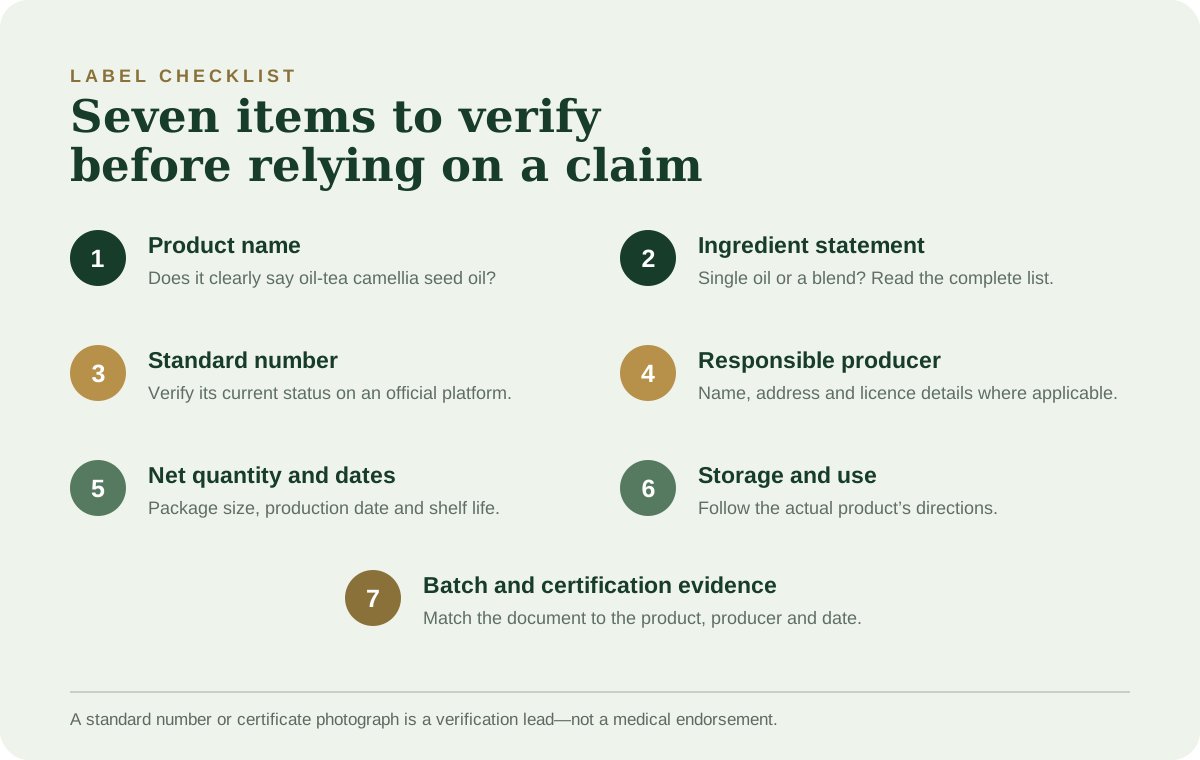
A useful label identifies the responsible manufacturer or importer, address, contact route, net quantity, production date, shelf life, lot or batch information and storage directions. Those fields let you ask a seller a specific question and make a later complaint traceable. A QR code can be helpful, but it is not a substitute for readable mandatory label information.
You may see references to GB/T 11765-2018 for oil-tea camellia seed oil, GB 2716 for vegetable oils, or GB 7718 for general prepackaged-food labelling. Record the number, then check its current title, status and scope on the SAMR National Standard Information Public Service Platform. A standard number is a reference point, not a laboratory certificate or a guarantee that a listing is compliant. Our standards guide explains how to read those references.
Separate a single oil from a blend
Do not treat ‘tea oil’ as a guarantee that the bottle contains only Camellia seed oil. If the label says 调和油, read the full 配料 statement and any stated proportions. A blended edible oil can be a legitimate product; it simply needs to be described as a blend rather than assumed to be pure tea seed oil.
Likewise, ‘压榨’, ‘冷压’, ‘有机’, ‘天然’ and ‘特级’ describe different process, certification or marketing claims. They do not replace the ingredient statement. Certification claims should be checked against the named certifier or official mark where one is provided.
For overseas buyers, request the missing evidence
International listings often crop out the Chinese back panel or replace it with a short English title. Before paying, ask for clear images of every label panel, the importer or seller identity, the lot number, production date, shelf life, storage instructions and the exact intended use. Check that the package you receive matches the images.
For a high-value purchase or a claim that matters, ask whether a certificate of analysis (COA) is available for the same batch. A useful COA names the product and batch, test date, laboratory and methods; it may include fatty acids, acid value, peroxide value, contaminants or residues. A generic PDF with no batch match is background material, not proof about your bottle.
Also consider the journey: long exposure to heat or light can affect an edible oil even when the original label was complete. Check the seal, leakage, cloudiness or unusual odour on arrival, then follow the product's storage directions. Do not taste an unknown or incorrectly labelled oil to test authenticity.
Storage and use details matter after purchase
Follow the bottle's storage and use directions, especially after opening. Heat, light, air and time can affect any edible oil, so a product-specific instruction is more useful than a universal shelf-life promise. Keep the cap clean and closed, and avoid transferring the oil into an unlabelled container if you need to preserve batch or date information.
If the listing omits the ingredient panel, food-use direction or a responsible contact, choose a better-documented option or ask for the missing information before buying. If the received bottle is leaking, unsealed, incorrectly labelled or materially different from the listing, document it with photographs and contact the seller rather than trying to diagnose authenticity in the kitchen.
Price, smoke point and appearance are not shortcuts
A low price can reflect a smaller package, a sale, a different harvest, processing, shipping or a blended formula. It is a reason to read more closely, not proof of adulteration. A high price is no proof of purity either.
Colour, clarity and aroma can vary with cultivar, filtration, refining and storage. The often-repeated 252°C smoke-point figure is a secondary reference for some refined oils, not a universal product specification; our smoke-point guide explains why. Composition charts have the same limitation: a fatty-acid range describes tested samples, not every bottle.
A 60-second buying decision
- Is this clearly labelled for food use, rather than cosmetics or essential-oil use?
- Does the Latin name or Chinese ingredient wording identify what the seller means by camellia oil?
- Does 配料 show a single oil or 调和油 and other ingredients?
- Are the producer or importer, 生产许可证编号, 净含量, production date, shelf life, lot and storage directions visible?
- If a standard or certification is cited, can you verify its current status and scope?
- For an overseas purchase, do the label images and any COA match the exact batch and package?
What a label review cannot prove
A label review can clarify what a product claims to be and expose missing information; it cannot independently verify laboratory purity, pesticide residues, freshness or a health outcome. Those questions require product-specific documentation and, where relevant, qualified professional or laboratory review. If the essential fields are hidden or contradictory, the sensible choice is to pause and ask for evidence rather than fill the gaps with assumptions.
Source notes
References used on this page
- 01SAMR — Official standards lookup for GB/T 11765-2018, GB 2716 and GB 7718
- 02Kew Science — Plants of the World Online search for Camellia oleifera
- 03Codex Alimentarius — International food standards directory
A database search page helps readers locate the literature; it does not mean every indexed study supports every claim. We identify individual studies when discussing a specific result.
This page was reviewed on July 25, 2026. See our editorial policy or report an error.