
Standards guide
Chinese Tea Oil Standards: What Should a Label Show?
A reader-focused guide to China’s GB/T 11765 oil-tea camellia seed oil standard, broader food-safety standards and the limits of certification claims.
Direct answer
A Chinese tea oil label should identify the product name, ingredient, net quantity, responsible producer and applicable standard. GB/T 11765-2018 is the product standard commonly associated with oil-tea camellia seed oil, while mandatory food-safety standards cover broader issues such as vegetable-oil safety, contaminants and residues.
Key facts
- Chinese product name
- 油茶籽油
- Product standard reference
- GB/T 11765-2018
- Standard type
- Recommended national product standard (GB/T)
- Separate requirements
- Mandatory food-safety and labeling rules
- Organic claim
- Requires separate certification evidence
Start with the standard number
Chinese packaged foods normally identify an applicable product or food-safety standard. For oil-tea camellia seed oil, GB/T 11765-2018 is an important reference to look up on China’s official national-standard platform.
The number should be read as a traceable reference, not as a health endorsement. A printed standard number does not by itself prove that a particular batch passed every required test.
Product standards and safety standards do different jobs
A product standard describes the named oil category and relevant technical requirements. Mandatory national food-safety standards apply across broader categories. Examples that may be relevant to edible oils include GB 2716-2018 for vegetable oil, GB 2762-2022 for contaminants in foods and GB 2763-2021 for maximum residue limits for pesticides in foods.
Standards can be amended, replaced or supplemented. Importers and publishers should verify current status on an official platform rather than copying an old list from a marketplace page.
A practical label checklist
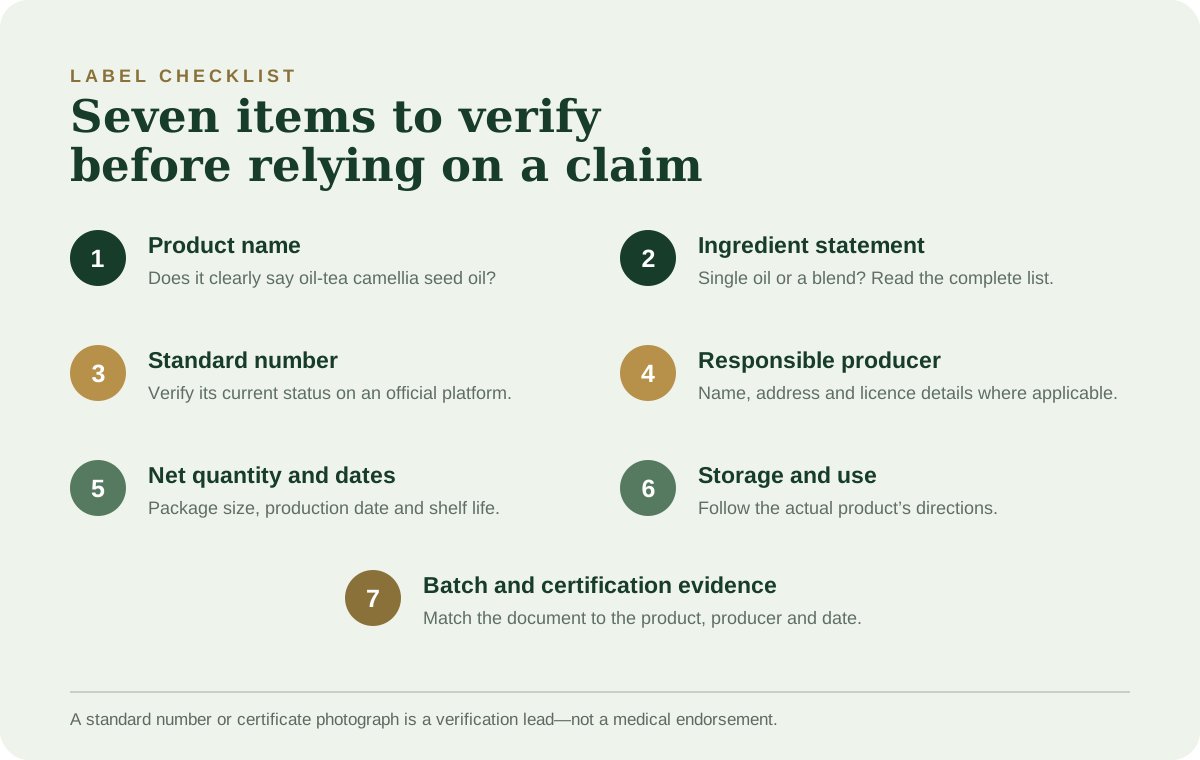
- Product name and complete ingredient statement
- Net quantity and date or shelf-life information
- Producer name, address and production-license information where applicable
- Applicable standard number
- Storage and use directions
- Batch-specific laboratory or certification documents for claims that require them
For translations of 山茶油, 油茶籽油, 压榨, 浸出, 调和油 and the common quality grades, use the complete label-first buying guide.
Organic is a separate claim
An organic statement should be supported by a valid certification scope that matches the product, producer and certification period. A photograph of a certificate is a starting point for verification, not sufficient proof on its own.
Pure Oleifera does not treat producer advertising graphics as independent confirmation of organic status.
Export labels need destination-market review
A product that follows Chinese requirements may still need different nutrition, language, importer and claim information in the country where it is sold. This guide explains source documents; it is not a substitute for destination-market legal review.
Source notes
References used on this page
- 01SAMR — National Standard Information Public Service Platform
- 02National Health Commission of China — Food safety standards
- 03Codex Alimentarius — International food standards directory
A database search page helps readers locate the literature; it does not mean every indexed study supports every claim. We identify individual studies when discussing a specific result.
This page was reviewed on July 25, 2026. See our editorial policy or report an error.